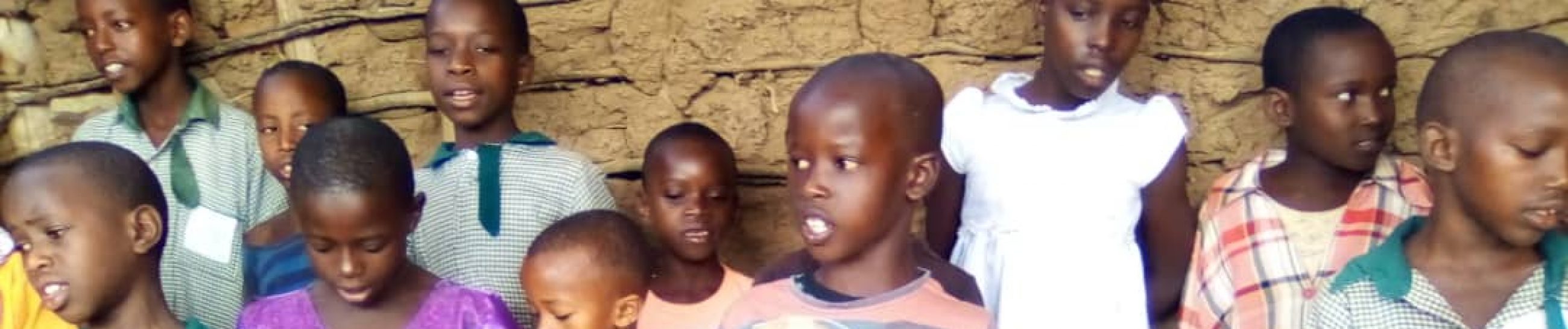

We are very proud to announce that our Ndagwe sub-county apprenticeship students who have participated in our KCDO programs have graduated and are ready to begin their skilled careers. They have been trained in motorcycle mechanics, hair dressing, tailoring and knitting. They have been trained for one year under local artisans in their home area. They have been examined and certified by the government of Uganda and awarded with certificates and tools to start their own business. In addition to receiving individual tools, they have also received toolkits as as group to encourage working together. Individuals are grouped into small groups. Each group of 5-10 people has received a startup fund of $90 for renting a house where they can start and set-up their joint businesses. This success story was made possible with the help of Rakai Health Sciences Program, Lwengo District local government and KCDO. We are most grateful to our partners. Through their generous support, these young people are enabled to achieve financial independence. As a group, they will strengthen our local economy.

Water Purifiers Success Story
Compiled by Wakimwere Arnold, KCDO field officer
Introduction
During our home visit in the household, we found out that most of our clients get water from different sources like boreholes, harvesting it from rain, wells, streams, ponds among others. Through the assessment done by the staffs Kyamaganda Community Development Organization(KCDO), most of the households in sub-county of Kisekka access water for drinking from streams and ponds which expose them to taking contaminated water thus likely to be exposed to water born diseases like typhoid fever, is well-known in extremely poor parts of developing nations; it’s estimated that up to 20 million people worldwide suffer from the illness each year. It’s spread through contaminated food, unsafe water, and poor sanitation, and it is highly contagious, Cholera which is commonly found in humanitarian emergencies or marginalized villages where poverty and poor sanitation are rampant. The disease is spread through contaminated water and causes severe dehydration and diarrhea. Cholera can be fatal within days or even hours of exposure to the bacteria, but only 1 in 10 people will develop life-threatening symptoms, dysentery also a waterborne disease characterized by severe diarrhea as well as blood or mucus in the stool. It can be caused by bacteria, viruses, or parasites in unsafe food and water, Hepatitis A is a liver infection caused by consuming contaminated food and water, rural communities with poor sanitation and hygiene management are most exposed to the disease.
Photo below shows children fetching water in a stream in kisekka sub – county


Following the observation in the introduction above, with support from USA-KCDO Partners Kyamaganda Community Development Organization (KCDO) implemented Health Systems Strengthening Project in two sub-county Kisekka sub – county and Kinoni Town Council targeting households infected and affected by HIV/AIDS and other vulnerable Status. This was achieved through working with different stake holds I.e health centers, Village Health Teams(VHTs) Community Development Officers(CDOs)Local Council Leaders (LCs) Para-Social Workers(PSWs) and Volunteers that deliver comprehensive services of Health and treatments to affected and infected households by HIV/AIDS and other Economic empowerment and Water and Sanitation to different vulnerable people in the community.
A total number of 100 household were reached and received solar bag for domestic use.
KCDO staff demonstrating how to use solar bag. KCDO staff handing over solar bag to a client


ACHIEVEMENT:
Since these Solar Bag is a sunlight-activated reusable water purifier that destroys or reduces the broadest range of contaminants without pumping, electricity, chemicals or replaceable components. This has reduced the spread of various water born diseases as the members are able to purify water to kill all the germs and Chemical Contaminants like; Pesticides, Herbicides, Insecticides, Cleaning Solvents, Petrochemicals, Pharmaceuticals, Pathogens- Bacteria, Viruses, Protozoa before drinking through simply placing the Solar Bag in the sun for a few hours, and enjoy purified water.
While caring out a follow up and monitoring on the usage of this purifiers in the community and household being supplied with the water solar bags, we observed that these water solar bags have helped the individuals so much, in the way that individuals use this solar bags on the daily basis to purify water for drinking, they extended their sincere appreciation to kcdo and our partners at large for bringing up such a wonderful idea of protecting and living a health life. One of the household of lutaaya jamewo upon reaching there on the ground, we found children happily looking on as the solar bag full of water placed on the Jeri can.

KCDO staff conducting a follow up in kyasonko village kisekka sub- county

KCDO staff and a child from the home study taking water purified using a solar bag.
Conclusion
The needs of OVC or otherwise made vulnerable by HIV/AIDS are cross cutting as many of them dramatically escalates from economic, health and household social issues. It would be necessary for KCDO and partners to jointly continue to work with local families, communities, and other organizations in a similar setting to focus their program and policy development efforts on ensuring the survival of these OVC households in breaking the cycle of poverty, despair, in regard this can make positive and measurable contributions to the improved health, safety, and happiness of the HIV+ (OVC) in the most appropriate environments for their development. We extend our warmly appreciation to our partner who donated us the purifiers to improve on the life of the people in rural based communities of kisekka and kinoni and ready to continue working with them in any way, God bless.
Compiled by Wakimwere Arnold

Peace Corps Donates Mosquito Nets
Willy writes, “I Am happy to inform you that we secured 400 mosquito nets for our supported children.”

“The nests were donated by Peace Corp Uganda through Lwengo District local government.”


“Uncle Jackson Wadidi and leader of the Catholic laity, Mr. Lubega, showing how to lay out mosquito nets before use, and sharing learning materials to study at home with children.”


“We are happy and hearts rejoicing today as we have distributed mosquito nets and lockdown learning materials to vulnerable households in Lwengo District.“

Rakai Health Sciences Program promotes Women’s Entrpreneurships, supports Child-headed Households
This morning KCDO gratefully received direct assistance from the Rakai Health Sciences Program, an organization sponsored by Johns Hopkins University. Rakai has previously provided 5 years of HIV medicine and research for local KCDO children afflicted with HIV.

Bukenya Willy, Executive Director of KCDO, writes, “Am happy to inform you that Rakai Health Sciences Program has supported more women and child-headed families with income generating projects to ensure sustainability and family improvements in income levels.”


Bukenya Willy continues, “The support includes retail shop items, charcoal sellers, farm inputs like vegetable seedlings, herbicides, fertilizers, spray pump.”


“Watering cans were given to all HIV positive children so that they can help in the gardens.”

Receiving these gifts is both a great achievement and a great blessing. KCDO’s ongoing positive relationship with Rakai has helped secure this important assistance. These products will give women and children the ability to work to sustain their own families so that they can have independence and security.

Piggery Pop-Up
The Covid-19 pandemic has reached Uganda, and KCDO offices are being closed; the piggery is being temporarily disbanded. Fortunately, notwithstanding the pandemic, the KCDO piggery is providing frontline micro-economic opportunities for local women in the Lwengo District of Uganda.

As Jack Neighbor notes in a recent article in National Geographic, “Women have long been underestimated and underutilized in many societies, including across Africa. Now, through hard work, global commitments, and localized training initiatives, women entrepreneurs are making their mark on the economies of southern Africa.”

To Neighbor’s point, both the piggery and KCDO are using this opportunity to provide 20 local women with booster grants and materials to start their own businesses. KCDO has been teaching entrepreneurial skills for the past year. The women graduates are now provided with the tools for success.

Willy writes, “Am happy to inform you that today, Saturday, we have been able to support 20 women with income generating projects to assist them in these trying moments. 10 women got pigs, animal feed and booster feeds to start their own piggery schemes at the household level. Others have got retail shops items like merchandise goods, drums for brewery, seedlings, fertilizers since its planting season, among others.”
And he says,
“We are grateful to Wonderland BookSavers and the team who helped us start the piggery project that is supporting other small businesses for rural poor women in Kyamaganda community and Lwengo District.”
This is a great example of successful micro-entrepreneurship, which started with a fund-raising pool party in the USA and 8 months later concludes with financial independence for 20 women and their families in Uganda.
“Be devoted to one another in love. Honor one another above yourselves.” Romans 12:10

Local Principals Expand School Libraries
Donations of books, soccer balls and T-shirts were recently received by the principals from local schools in the Kyamaganda community. Donations were sent by US-Africa Children’s Fellowship and Wonderland BookSavers.

These boxes of books and school supplies have traveled from the US to Zimbabwe and then, with great difficulty, to the Kyamaganda Community Development Organization, where they are being sorted so that they can be shared between the KCDO library and local schools.


KCDO students are currently on school holiday. When they return, they will be greeted by many new books, both textbooks and children’s fiction. The soccer balls will be the best surprise!